


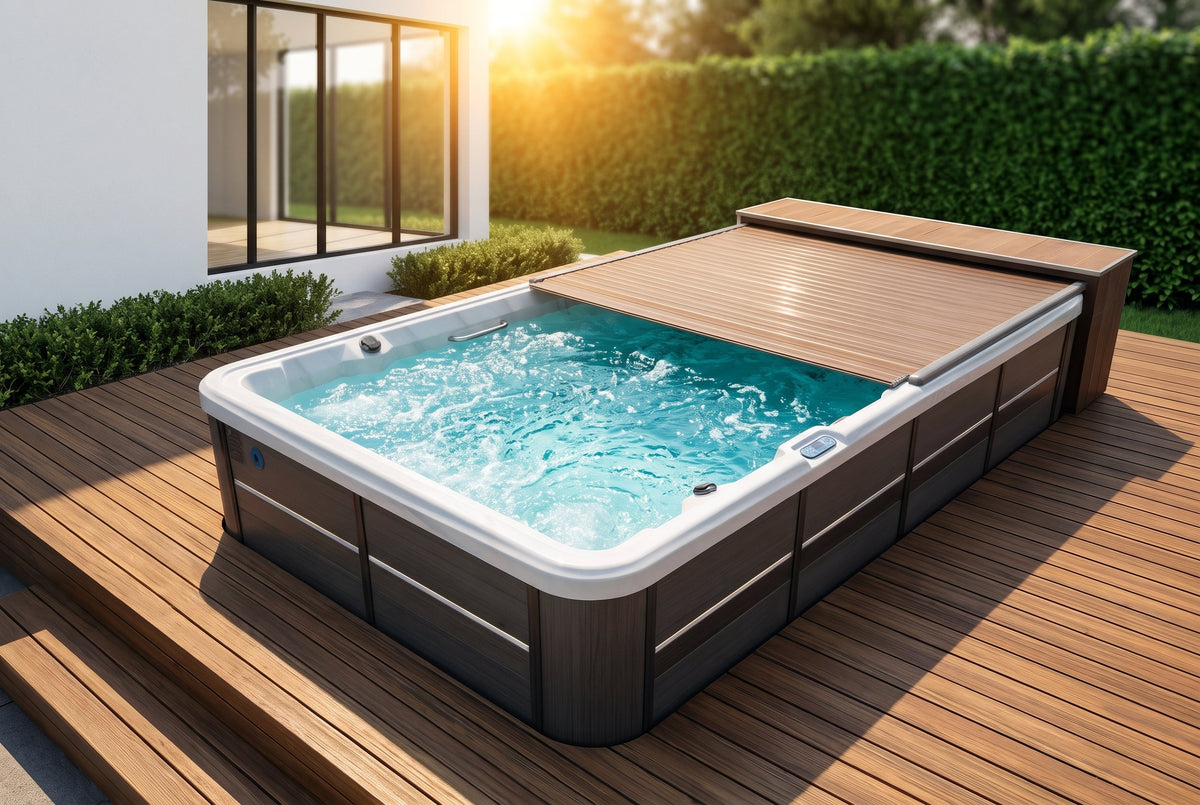
When Australians search “plunge pool cost”, the most useful number is not the price of the pool shell. It is the cost of getting the entire project delivered, installed, compliant, landscaped and operating.
That distinction explains why published plunge-pool cost guides can vary so widely. Some figures refer mainly to a shell or product; others include more of the installation and surrounding project.
Rather than relying on one national headline figure, build your budget in layers.
A practical way to calculate the project is:
Pool or shell cost
+ delivery and crane cost
+ excavation and site works
+ plumbing and filtration
+ electrical
+ heating or cooling
+ pool safety compliance
+ decking, paving or coping
+ landscaping
+ ongoing ownership costs
= real plunge pool cost
This is why a pool advertised at one headline price does not necessarily become a backyard project at that same price.
The starting product can be a fibreglass shell, precast concrete pool, custom concrete pool or another prefabricated system.
This number is useful only once you know what is included. A shell without filtration, installation and site works should not be directly compared with a product containing its pumps, filtration, controls and heating system.
If your main question is specifically about purchase price rather than whole-project cost, see our separate Plunge Pool Price Australia guide.
For an in-ground plunge pool, excavation can become one of the least predictable parts of the project.
Cost can change because of rock, difficult soil, restricted machinery access, sloping land, retaining walls, spoil removal, groundwater, engineering requirements and existing structures.
A small pool does not automatically mean a simple excavation. In fact, many plunge pools are chosen because the property is compact — which can also mean access is more difficult.
A prefabricated shell still has to reach the backyard. If direct access is unavailable, a crane may be required.
Crane requirements can change with reach distance, product weight, road access, neighbouring buildings, trees, overhead services and the distance between the truck and final position.
The same product can therefore have very different placement costs at two different homes.
Ask whether the initial price includes filtration, circulation pumps, sanitation equipment, plumbing components, lights, controls, heating equipment and a cover.
With a conventional plunge pool, these may appear as separate equipment items or packages. With a manufactured swim spa, much more of the operating system is already integrated into the unit.
That is one reason the two purchase prices cannot be compared without checking inclusions.
Electrical requirements depend on the equipment being installed and the property itself.
The quote may need to allow for cabling, isolation, switchboard work, circuit protection, equipment connection and the distance between the switchboard and pool or spa equipment.
Always use the actual electrical specification of the selected product and obtain advice from a suitably licensed electrician. Our spa electrical requirements guide explains why requirements should be checked by model rather than assumed across the range.
A plunge pool designed only for warm-weather use has a different cost profile from one expected to operate comfortably throughout winter.
Heating equipment adds both an upfront equipment cost and an ongoing energy cost.
If cooling is also important, confirm whether active cooling is actually included rather than assuming that any heater can cool the water. Capability varies by equipment and product configuration.
Compliance should be in the original budget, not treated as an optional extra after the pool has arrived.
Requirements differ between Australian states, local authorities and individual installations. A compact or self-contained water body is not automatically exempt simply because it is called a plunge pool, spa or portable pool.
Before ordering, confirm the safety-barrier, approval, registration, inspection or certification requirements that apply to your property with the relevant state or local authority.
This is where a simple pool project can become a premium backyard project.
Possible costs include decking, coping, paving, drainage, retaining walls, screens, outdoor lighting, steps, planting, seating areas and outdoor structures.
There is nothing wrong with investing more in landscaping — it may be the feature that makes the finished space exceptional. The problem occurs when the original “pool cost” comparison leaves it out completely.
The total cost does not stop when installation finishes.
Over several years, consider electricity, heating, filtration, chemicals, water replacement, cleaning, replacement consumables, servicing, covers and equipment repairs.
A more useful long-term comparison therefore looks at initial project cost + annual operating cost + maintenance cost.
A buyer wanting the compact rectangular look of a plunge pool can also compare a manufactured swim spa.
The key difference is that a swim spa arrives as a largely complete water system.
The Express Lane 4.5m currently starts from $19,490 for the Standard configuration, while the Express Lane 6m currently starts from $21,490 for Standard, as at September 2026.
Those are product prices rather than universal installed-project prices.
You still need to consider the supporting base, electrical work, freight, access, crane placement where required, safety compliance and optional landscaping. But you are generally preparing the property for a manufactured product rather than constructing the pool system itself on site.
Important: Express Lane is a swim spa, not a conventional plunge pool. It is included here because its long rectangular layout can suit buyers comparing compact backyard water options.
| Cost Area | Traditional Plunge Pool | Express Lane Swim Spa |
|---|---|---|
| Main water vessel | Separate shell or construction | Included |
| Pumps | Separate or package dependent | Integrated |
| Filtration | Separate or package dependent | Integrated |
| Controls | Equipment dependent | Integrated |
| Swim-current system | Usually additional | Integrated |
| Hydrotherapy | Optional | Integrated |
| Heating | Often separate | Integrated, configuration dependent |
| Excavation | Common | Not inherently required |
| Base preparation | Yes | Yes |
| Electrical | Yes | Yes |
| Freight or crane | May apply | May apply |
| Safety compliance | Applies as required | Applies as required |
| Landscaping | Usually part of project | Optional design choice |
| Ongoing operation | Yes | Yes |
When comparing your options, prepare two budgets.
Include everything required to get the product ready for use: purchase, delivery, site works, electrical, compliance and landscaping.
Then consider the next several years of electricity, water treatment, servicing, filters, covers and maintenance.
A product that costs more initially can have a different ownership profile from a cheaper shell requiring more equipment and construction. The reverse can also be true.
The purpose is not to assume one category always costs less — it is to compare the same scope of ownership.
Put every quotation into the same structure:
Only then are you comparing like with like.
Imagine two advertisements: one is for a plunge-pool shell and the other is for a self-contained swim spa. The shell may show the lower starting price, but that tells you little about the completed project.
If the shell still requires excavation, equipment, crane placement, electrical work, heating, safety barriers and landscaping, while the swim spa already contains much of its mechanical system, the initial product-price difference may not reflect the final ready-to-use cost.
Conversely, if the site is already prepared and the plunge-pool package includes most of the required equipment and work, the traditional pool may be very competitive.
This is why the most useful figure is the ready-to-use total for your own property.
Approximately 4.5m × 2.28m × 1.52m, with approximately 6,870L published water capacity.
Current Standard price: from $19,490.
Approximately 5.9m × 2.28m × 1.52m, with approximately 9,460L published water capacity.
Current Standard price: from $21,490.
Prices and configurations shown as at September 2026 and can change. The live product page is the authoritative source when ordering.
There is no single reliable all-in figure for every property. The pool type, construction method, excavation, access, equipment, compliance, landscaping and desired finish can materially change the project cost.
Because the shell may be only one part of the project. Excavation, freight, crane placement, plumbing, equipment, electrical work, safety requirements and landscaping can all sit outside the shell price.
Sometimes, but not universally. A swim spa has a different cost structure because much of the mechanical system is already incorporated into the manufactured product. Compare complete ready-to-use costs for your property.
Yes. Allow for an appropriate supporting base, electrical connection, freight, access or crane placement, compliance requirements and any optional landscaping.
Access, excavation, crane work, compliance and landscaping can be overlooked when a comparison focuses only on advertised product pricing.
Yes. The 4.5m has a smaller footprint, while the 6m offers more open-water length. The final choice should consider both available backyard space and delivery access.
Do not begin with “What is the cheapest pool I can buy?”
Begin with “What will my complete ready-to-use project cost, and what functionality will I get from it?”
That one change makes plunge pool cost comparisons much more useful.
For buyers who want a compact rectangular water space but also want swimming, hydrotherapy and temperature control, compare the Express Lane 4.5m and Express Lane 6m before committing to construction.
Massage Spas Australia: How to Choose a Spa for Better Jet Massage
Looking for massage spas in Australia? Learn how jet placement, pump power, seating and adjustability affect spa massage, and compare current spa pool options.
Plunge Pool Brisbane: Cost, Cooling & Swim Spa Alternatives in 2026
Looking for a plunge pool in Brisbane? Compare traditional plunge pools with Express Lane 4.5m and 6m swim spas, including cost, cooling, installation and Queensland requirements.
Plunge Pool Cost Australia: What Does the Whole Project Really Cost?
What does a plunge pool really cost in Australia? Build a complete budget for the pool, site works, electrical, safety compliance, landscaping and ongoing ownership before comparing alternatives.

Mon–Fri: 9 am–9 pm
Sat–Sun: 9 am–3 pm
© 2026 Spas Wholesale. Proudly Serving Australian Families.


Share:
Plunge Pool for Sale Australia: What to Compare Before You Buy
Plunge Pool Brisbane: Cost, Cooling & Swim Spa Alternatives in 2026