


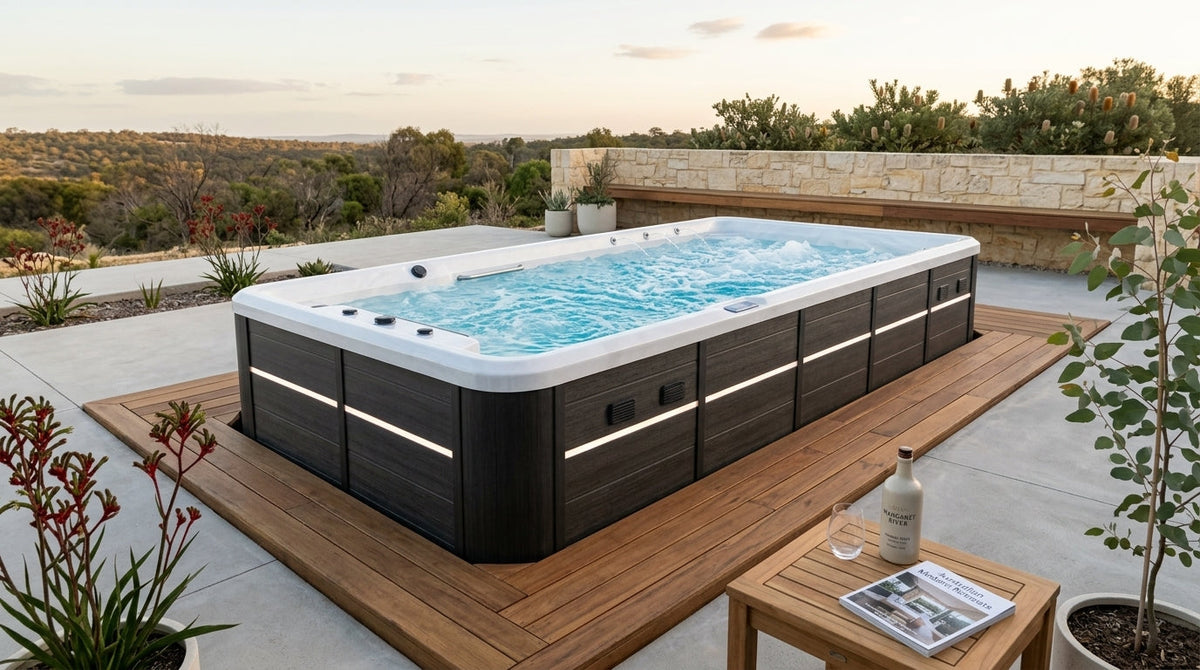
A plunge pool in Australia can make sense when you want a genuine backyard water space but do not have — or do not want to give up — the area required for a full-size swimming pool.
Australian backyards are often space-conscious, which is one reason compact pools are increasingly positioned around courtyards, narrow yards and smaller outdoor-living areas.
But choosing the right plunge pool involves more than deciding whether it looks good.
Australian buyers need to consider climate + backyard size + pool type + site access + heating + safety + total installed cost.
A plunge pool is generally a small swimming pool designed around compact recreation, relaxation and cooling rather than long-distance lap swimming.
It can be concrete, fibreglass, precast concrete, round, rectangular, in-ground, partially raised or above ground.
There is no single shape that defines the category.
The most obvious advantage is footprint.
A smaller water area allows more room to remain available for entertaining, garden, lawn, outdoor kitchen, decking, children's play and circulation.
This can be particularly valuable on newer or inner-city properties where the backyard needs to serve several purposes.
A pool that leaves no usable outdoor area around it is not necessarily the best solution simply because it physically fits.
Australia does not have one uniform pool climate.
Cooling may be a major reason for buying.
Active cooling capability can therefore become relevant when comparing alternative products.
Buyers may want a balance between summer recreation and extended seasonal use.
Heating can become much more important if the objective is regular use beyond summer.
Hot, dry conditions make cooling attractive, while evaporation, sun exposure and landscaping also need consideration.
Hot summers make compact pools appealing, while site conditions and seasonal use still determine the best heating strategy.
This is why “best plunge pool Australia” cannot sensibly mean the same product for every state.
Best when custom design is the priority.
You can specify shape, dimensions, depth, finish, seating, steps and integration with architecture.
However, this generally involves the greatest amount of site-specific construction.
A preformed fibreglass shell can reduce some construction compared with a fully custom concrete vessel.
The trade-off is choosing from available shell dimensions.
Access for delivery remains important.
A precast pool is manufactured before delivery and lifted into position.
This can combine concrete construction with reduced on-site pool forming.
Crane and property access still need to be assessed.
Above-ground or partially raised pools can work well where excavation is difficult, the site slopes, the house floor level is elevated or an architectural feature is preferred.
Decking can visually integrate the pool without completely burying it.
This article deliberately does not duplicate our dedicated price pages.
There are two different questions:
See Plunge Pool Price Australia.
See Plunge Pool Cost Australia.
The distinction matters because final budgets can include excavation, soil removal, crane, engineering, pool equipment, electrical, heating, pool barriers, approvals, paving, decking, retaining structures and landscaping.
A small pool is not automatically a small project.
Do not assume a compact pool is exempt because of its size or because it is marketed as a plunge pool.
Pool and spa safety requirements vary by state and the specific installation.
Before construction, confirm the requirements applying to your state + council/property + pool design.
This should happen before the landscaping and barrier layout are finalised.
Ask whether the pool will be used primarily for summer cooling or year-round water use.
If the answer is year-round use, heating should be considered at the design stage rather than added as an afterthought.
The same applies to a desire for colder water.
Not every heating system can actively cool.
Some Australian buyers searching for a plunge pool actually want several functions from the same backyard space: cooling, swimming, exercise, heating, massage and family recreation.
This is where a swim spa becomes worth comparing.
| Feature | Traditional Plunge Pool | Express Lane Swim Spa |
|---|---|---|
| Compact rectangular format | Yes | Yes |
| Conventional pool | Yes | No |
| Resistance swimming | Usually not standard | Yes |
| Massage seating | Optional | Integrated |
| Filtration | Pool system | Integrated |
| Heating | Optional / system dependent | Integrated/configuration dependent |
| Major pool construction | Common | Reduced |
| Potential relocation | Generally no | Possible after proper disconnection/moving |
Express Lane is a swim spa — not a conventional plunge pool.
Current specification:
Dimensions: 4.5m × 2.28m × 1.52m
Standard price: $19,490
Standard temperature range: 25°C–40°C
Selected Pro / Pro Max: 5°C–40°C where the specified reverse-cycle heat pump is included
Insulation: ecoWARM™ Thermal Guardian Technology
This size is most relevant where the buyer wants to retain as much of the backyard as possible.
Current specification:
Dimensions: 6.0m × 2.28m × 1.52m
Standard price: $21,490
It is aimed at buyers who want more swim length and have enough outdoor space and access for the larger product.
Both products are available in multiple configurations, so current variant pricing and equipment should be checked live.
Prices checked October 2026.
There is no national answer.
Always measure the delivery route, not just the finished position.
Sydney buyers need to consider site access, slopes, established neighbourhoods, property density and seasonal heating.
See our dedicated Plunge Pool Sydney guide.
For Melbourne, year-round temperature use becomes a stronger buying consideration.
See our dedicated Plunge Pool Melbourne guide.
In Brisbane, cooling and warmer-weather use become more prominent.
See Plunge Pool Brisbane for the Queensland-focused comparison.
Perth buyers should consider hot, dry conditions, exposure, water management and installation access.
See our Plunge Pool Perth guide.
Spas Wholesale does not sell conventional concrete or fibreglass plunge pools.
Our relevant alternative is the Express Lane swim spa range.
This distinction is important for transparent buying information.
The products are supplied through:
5 Australian Warehouses. Direct Online Pricing. Local Sales & Support.
Free warehouse pickup is available by arrangement in NSW / VIC / QLD / SA / WA.
For genuinely in-stock products, dispatch is within 48 business hours, excluding weekends and public holidays.
That refers to dispatch, not guaranteed delivery.
They are a well-established small-pool category, particularly for properties where outdoor space is limited.
The best size depends on the yard and intended use. Do not sacrifice all surrounding outdoor space simply to maximise water dimensions.
Yes. Above-ground, raised and partially recessed designs exist.
Yes, depending on the equipment selected.
Normal lap swimming is limited by length. If stationary swimming is important, compare a swim spa.
Spas Wholesale's Express Lane products are swim spas, not conventional plunge pools. They are included as an alternative for buyers seeking a compact rectangular backyard water space with additional swimming and hydrotherapy functions.
Use this order:
purpose → backyard size → pool type → climate → access → heating/cooling → safety → total installed cost.
Then compare the final choice against the other compact-water options available to you.
That is much more useful than choosing the first pool that fits the available dimensions.
Plunge Pool Australia: Complete Buyer’s Guide for Australian Backyards 2026
Planning a plunge pool in Australia? Compare pool types, small-backyard options, climate, installation, heating, costs and swim spa alternatives before you build.
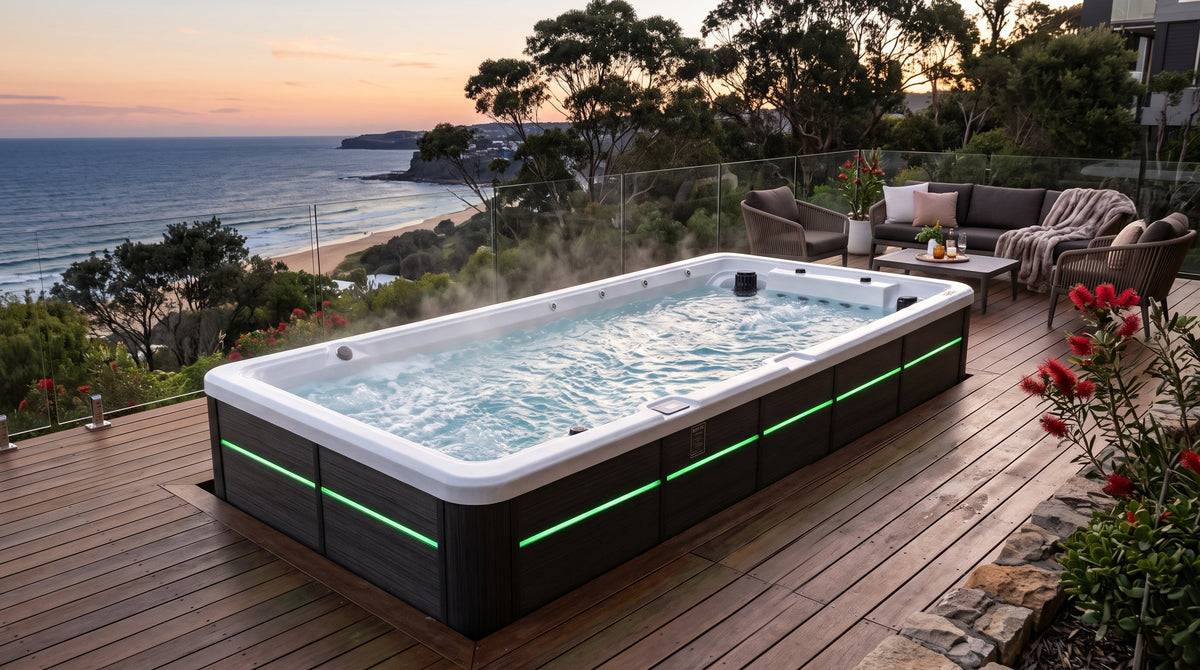
What Is a Plunge Pool? Sizes, Uses, Pros, Cons & Alternatives
What is a plunge pool? Learn how plunge pools differ from swimming pools, spas and swim spas, including sizes, uses, installation, benefits and limitations.
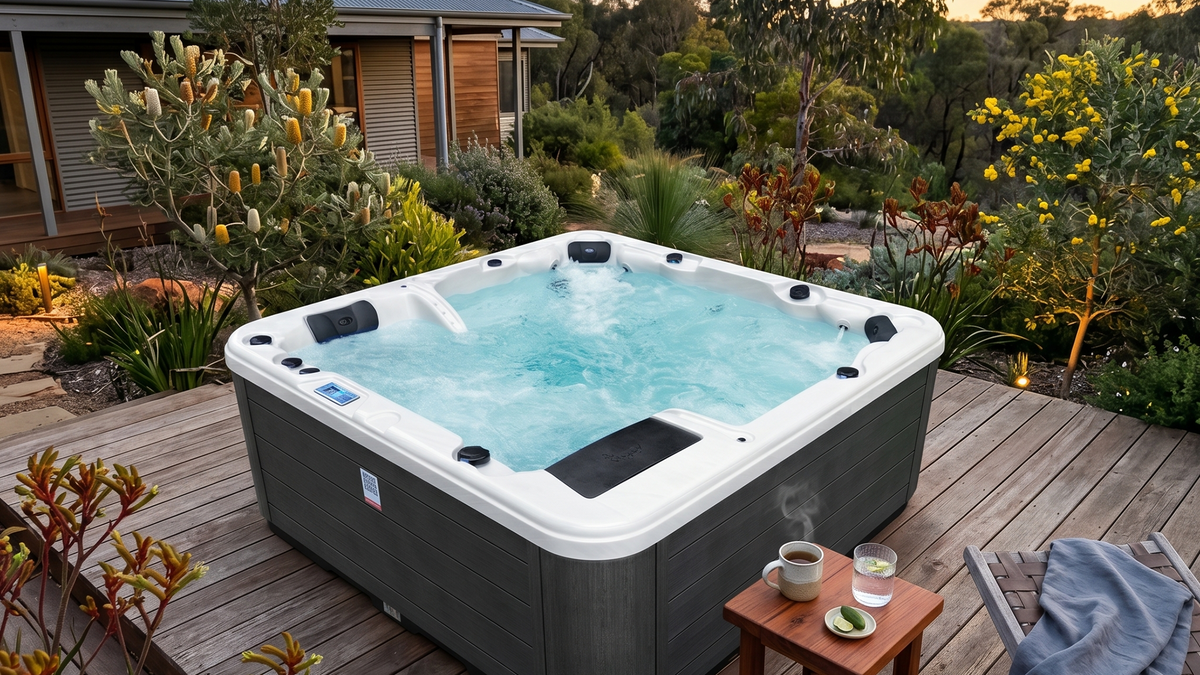
Portable Hot Tub Australia: Inflatable vs Rigid Hot Tub Buying Guide
Looking for a portable hot tub in Australia? Compare inflatable and rigid self-contained hot tubs, including size, power, massage, installation, insulation and warranty.

Mon–Fri: 9 am–9 pm
Sat–Sun: 9 am–3 pm
© 2026 Spas Wholesale. Proudly Serving Australian Families.


What Is a Plunge Pool? Sizes, Uses, Pros, Cons & Alternatives
What Is a Plunge Pool? Sizes, Uses, Pros, Cons & Alternatives